
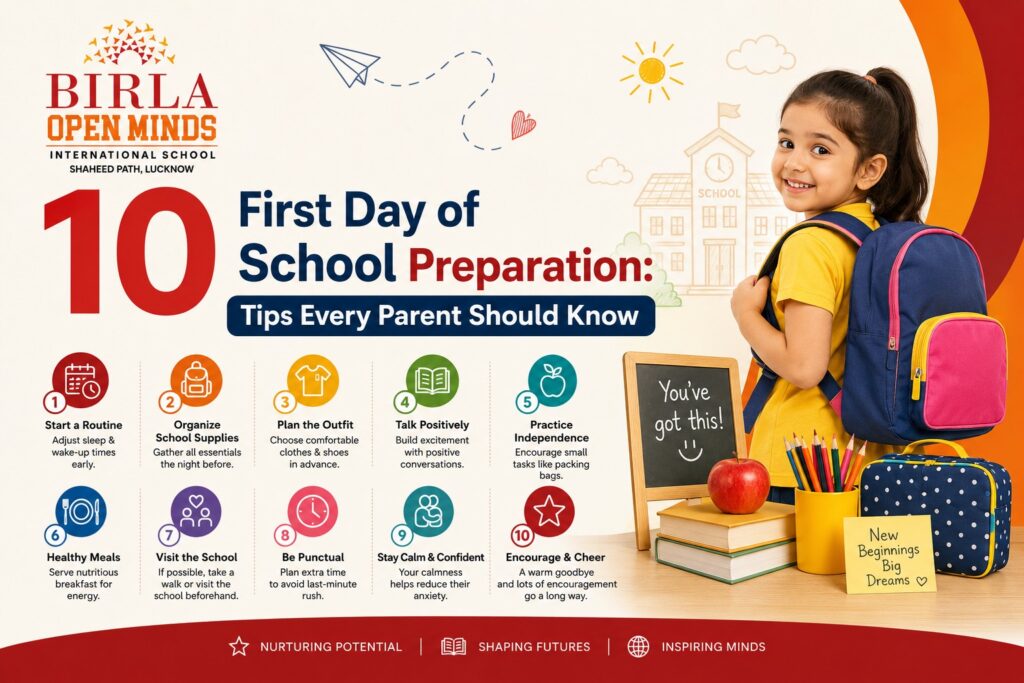
The first day of school is a milestone for your child, and honestly, for you too. It’s the beginning of something significant: new friendships, new routines, new discoveries. It can also bring nerves, uncertainty, and a few tears at the school gate. The good news is that most of that anxiety for both parent and child can be significantly reduced with the right preparation in the days leading up to it.
Here are ten practical tips every parent should know before that first morning.
1. Start the School Routine a Week Before
One of the best ways to prepare your child for the new school year is to start the school morning routine about a week before classes begin. Have your child wake up at the same time they would on school days. Eat breakfast together at the usual time, and encourage them to go to bed earlier each night.
Children function well with routine. Anxiety will be reduced immensely if the child feels comfortable with the mornings of the very first day of school.
2. Visit the School Together in Advance
Take your child to the school if possible before their first day there. Enter the premises through the main gate. Point out the place where they would be sitting, show them where the toilets are, and also where you’d pick them up. Give them a tour of the classroom and help them meet their teachers.
A new environment can make anyone feel intimidated. However, if a child is already familiar with the surroundings then they would go into the new place with a map of sorts inside their head. Our team at Birla Open Minds International School, Shaheed Path, encourages parents to come for a visit to the school beforehand.
3. Talk About School in a Positive, Honest Way
Children can detect a parent’s anxiety more quickly than parents themselves often know. Be very cautious in your expression of concern for your child’s ability to adapt. Focus on having a positive and curious conversation about what your child may learn, meet, and do in school.
Do not overreassure your child by telling him he will “absolutely be fine.” Do not also indulge in catastrophizing.
4. Read Books About Starting School
There is a wonderful range of children’s books about beginning school stories that normalize the experience, address common fears, and end with a child who found something to look forward to. Reading a few of these in the week before school gives children language for what they’re feeling and a narrative framework for the experience.
5. Let Your Child Pack Their Own Bag
Let your child have ownership of packing their bag by giving them all the supplies they need on the previous night and allowing them to put them in the bag themselves. It will make them feel confident and assure them that they are capable of going anywhere.
Double-check the essentials: water bottle, snack, stationery, and anything the school has specifically asked for on the admission and preparation checklist.
6. Practise the Drop-Off Goodbye
The drop-off is where first day anxiety typically peaks for children and parents alike. Practise a short, confident goodbye at home before the day arrives. A long, drawn-out farewell tends to amplify distress rather than reduce it.
Keep your goodbye warm, brief, and confident. Say something reassuring like, “I’ll pick you up at time. Have a wonderful day. I love you.” Then leave without lingering. Children often settle more quickly when goodbyes are calm and confident rather than long or emotional, a pattern teachers and child psychologists commonly observe.
7. Prepare for Big Emotions in Both Directions
Some kids breeze through their first day without looking back, while others have a hard time coping. This is entirely natural, and do not expect a specific response from your child, but be prepared for anything.
If your child finds the experience difficult, acknowledge the emotion but do not exaggerate it: “It’s fine if you are feeling nervous; it’s an unfamiliar environment, but you will adapt to it.” If he/she comes home feeling like it was the best day ever, be happy about it.
8. Plan Something Comfortable for After School
Have a plan for what happens when your child comes home. A familiar snack, a quiet afternoon, time to decompress. School is genuinely tiring for young children not because anything went wrong, but because navigating a new environment, meeting new people, and taking in new information requires real mental energy.
Give them space to process before asking a lot of questions.
9. Ask the Right Questions at the End of the Day
“How was school?” often produces “fine” and nothing else. More specific questions tend to open better conversations:
- What made you laugh today?
- What was the most interesting thing you learned?
- Who did you sit next to at lunch?
- What’s one thing you’re looking forward to tomorrow?
These questions invite reflection rather than just evaluation and they often reveal far more about how the day actually went.
10. Trust the Process and the School
Kids are incredibly adaptive. What seems massive on the first day becomes normal very soon. Each child goes through the phase differently, and generally, it takes less time than what parents think.
Select a school that encourages this process and where there is tolerance shown to kids on their first day, where the ambience is warm and inviting, and where the early years education process is focused on the curiosity of the child.
The early years programme at Birla Open Minds International School, Shaheed Path Lucknow, is created exactly in this way.
Admissions for AY 2026-27 are now open from Pre-Nursery to Senior Secondary levels.


